 Nexora Pest Control Service
Termite Treatment
Termites announce themselves two ways in Ashburn, and homeowners usually find one before the other. The first is a spring swarm — dark winged insects against a sunny window, or a pile of discarded wings on a windowsill…
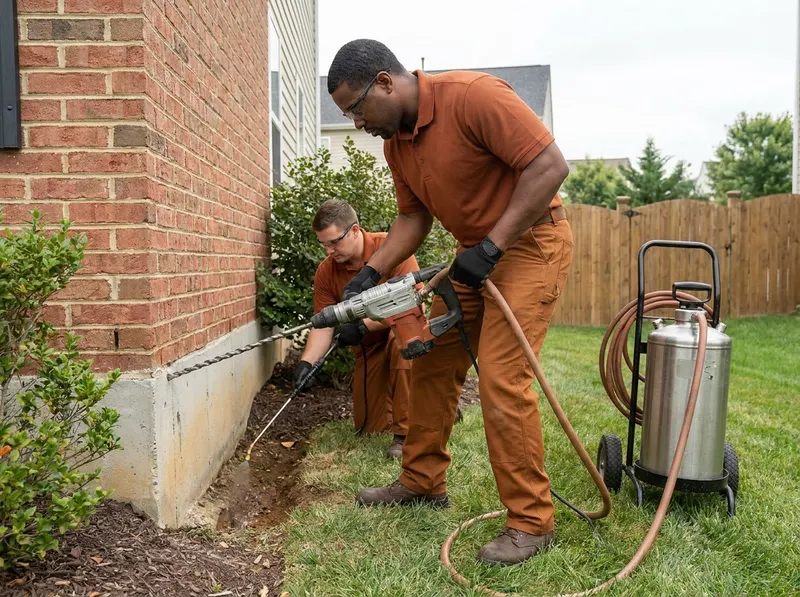
- Included: a full interior and exterior inspection, moisture readings at the sill plate and crawl space, a trenched-and-treated soil barrier or in-ground bait stations, treatment of slab expansion joints and utility penetrations, and a written diagram of every treated point.
- Timing: most Ashburn inspections are scheduled within a few business days; a standard single-family perimeter treatment is a one-day job, typically 3 to 6 hours depending on linear footage and how much mulch, shrub bed, or hardscape has to be worked around.
- Cost: termite work in the Ashburn market generally runs $250 to $3,200 — spot treatments sit at the low end, a full perimeter liquid barrier on a 2,500 sq ft home sits in the middle. Our minimum charge is $250.
- What we treat: soil against the foundation, crawl space piers, slab cracks and expansion joints, plumbing and electrical penetrations, wood-to-soil contact points, deck posts, and porch columns. Structural repair of damaged framing is a carpentry job we do not perform.
- Booking: call (571) 934-1689 for a free on-site inspection. Nothing is quoted sight-unseen and there is no obligation to buy a plan after the inspection.
Termites announce themselves two ways in Ashburn, and homeowners usually find one before the other. The first is a spring swarm — dark winged insects against a sunny window, or a pile of discarded wings on a windowsill or bathroom floor, most often between late March and May here. The second is a mud tube: a pencil-width dirt line running up a foundation wall, a crawl space pier, or the back of a basement stud. Ants leave neither. If you are seeing shed wings indoors, the colony is already in contact with the structure and a store-bought spray will not reach it, because the nest is in the soil and the workers are the only part you can see.
The choice is between a liquid soil barrier and a bait station system, and the right answer depends on your lot. A liquid treatment means trenching roughly six inches down along the foundation, applying a termiticide to the soil, drilling and treating through concrete where a patio, stoop, or garage slab meets the house, and backfilling. It kills on contact with the treated soil and starts working the same day — the better fit for an active infestation, and for the older sections of Ashburn Village and Ashburn Farm where deep mulch beds and railroad-tie edging sit right against siding. Bait stations are placed in the ground at intervals around the home and rely on foraging workers carrying the bait back to the colony; they take weeks to months to collapse a colony but require no drilling and far less soil disturbance. That makes them a reasonable option around finished hardscape, mature landscaping, or the tight townhouse footprints in Brambleton, Moorefield Station, and Loudoun Valley Estates where there is barely 30 inches between a foundation and a shared fence line.
Loudoun County conditions genuinely raise the pressure. The clay-heavy soil across Broadlands, Farmwell Hunt, and Goose Creek Village holds moisture against foundations long after a storm, and homes near the Goose Creek and Broad Run corridors — including the low, wooded stretches along the W&OD Trail — sit close to abundant buried wood: stumps, construction scrap, buried form boards. Slab-on-grade townhomes have no crawl space to inspect, so the first visible evidence is often at the garage-to-house wall or a baseboard behind the kitchen. Crawl-space homes in Belmont Ridge and Belmont Country Club give us more to work with: we can read moisture at the joists, check the vapor barrier, and see mud tubes on the piers directly.
We treat, then we seal and dry — grading soil away from the foundation, pulling mulch back off the siding, flagging downspout extensions and crawl-space vapor barrier gaps. That is the part spray-only outfits skip, and it is why re-treatments happen. If you are refinancing or selling, ask about a wood-destroying insect inspection report; lenders in Virginia commonly require the NPMA-33 form, and it is a separate visit from treatment. Products are applied per label to soil and structural voids rather than to living space, and we will walk you through re-entry timing for kids and pets before anything is mixed. Call (571) 934-1689 and we will look before we quote.
What it costs
Every job gets a firm, written price after a free on-site visit.
Common questions
How much does termite treatment cost in Ashburn?
When do termites swarm in Ashburn, and does a swarm mean my house is infested?
Do slab-on-grade townhomes in Brambleton and Moorefield Station need different termite treatment?
Is termite treatment safe around children, pets, and a backyard beehive in Ashburn?
Can you provide the termite letter my lender wants for an Ashburn home sale?
Ready to get started?
Tell us about your termite treatment job in Ashburn and we'll send a clear, written quote — usually the same day.